

Why Indigo Color Meaning Matters: Indigo sits quietly between blue and violet, yet it carries its own presence. It fills twilight skies, deep ocean depths, and ancient dyed fabrics. It also shows up in denim jeans, spiritual art, and the rainbow itself.
Indigo color meaning is often overlooked compared to brighter shades, but it holds real depth. It can point to intuition, wisdom, and spiritual insight. It can also point to mystery, introspection, and even melancholy. That range makes indigo one of the more fascinating colors to explore.
This guide covers the full picture. You will learn what indigo symbolizes, how indigo color psychology shapes mood, and how cultures and religions read this shade. You will also see indigo in nature, history, branding, fashion, dreams, and astrology.
General Indigo Color Meaning & Symbolism
Indigo is the color of quiet depth. It blends blue’s calm with violet’s mystery, creating a thoughtful, introspective energy. That blend is why indigo feels less direct than brighter colors.
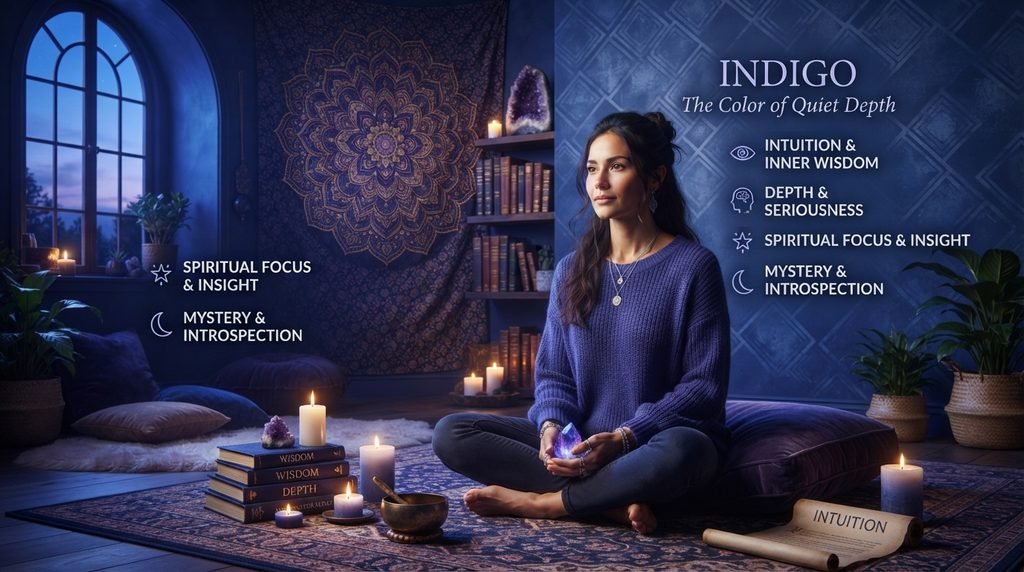
When people ask what indigo symbolizes, the answer often centers on intuition. Indigo also stands for wisdom, depth, and spiritual focus. It feels contemplative, like a mind turned inward.
Core Psychological Associations of Indigo
The core indigo color meaning is tied to insight and reflection. Indigo feels deep and serious without feeling harsh. It suggests a mind searching for meaning beneath the surface.
Most people connect indigo with a few main ideas:
- Intuition and inner wisdom
- Depth and seriousness
- Spiritual focus and insight
- Mystery and introspection
Positive Meanings of Indigo
At its best, indigo stands for wisdom, perception, and calm authority. It helps people feel grounded in thought rather than rushed by emotion. It also suggests a strong inner compass and clear judgment.
Indigo is often used where depth and focus matter most. Meditation spaces, spiritual art, and academic settings lean on it for this reason. In these settings, the meaning of indigo is thoughtful and steady.
Negative Meanings of Indigo
Indigo has a heavier side too. It can suggest isolation, sadness, or excessive seriousness. Too much indigo can feel distant or emotionally closed off.
Indigo can also lean toward obsession with detail, losing sight of the bigger picture. A space with only indigo may feel somber rather than peaceful. The meaning of indigo depends heavily on balance with lighter tones.
What Indigo Represents Overall
Indigo represents the space between knowing and wondering. It sits at the edge of blue’s logic and violet’s imagination. That in-between quality gives indigo its reflective character.
This dual nature explains why indigo can feel wise in one setting and heavy in another. A soft indigo twilight feels peaceful, while a dense indigo room feels closed in. Few colors balance clarity and mystery so evenly.
Indigo Color Psychology: How the Color Affects Mind and Body
Indigo color psychology looks at how this shade shapes thought and emotion. It has been studied less than primary colors like red or blue, since it sits further down the visible spectrum. Still, its effects are often described consistently across design and wellness contexts.

What we can say is that indigo tends to slow the mind down. It encourages reflection rather than quick reaction. Here is how it plays out.
Indigo Color Psychology and Mood
Indigo is often linked to calm focus and deep thought. Many people associate it with late evening stillness, a time often used for reflection. This connection makes indigo popular in spaces meant for study or meditation.
Indigo can also feel serious, sometimes bordering on somber. It lacks the playful energy of brighter blues or purples. This weight can support focus, but it may also feel heavy if overused.
Indigo and the Brain and Nervous System
Indigo sits close to blue on the spectrum, so it likely shares some of blue’s calming qualities. Claims about specific brainwave effects from indigo are not strongly confirmed by solid research. It is safer to describe indigo as emotionally introspective rather than physically calming in a measurable way.
Indigo also has one of the shortest wavelengths visible to the human eye, sitting near violet. This position may be part of why indigo often feels mysterious or hard to fully define. For contrast, red meaning leans toward urgency, while indigo leans toward quiet depth.
Why Humans React Thoughtfully to Indigo
Human associations with indigo may connect to twilight and the night sky. That transitional time between day and night often invites reflection and winding down. Indigo’s presence in that fading light may explain its link to introspection.
Over time, indigo also became tied to rare, precious dye, adding a layer of value to its meaning. That history strengthens indigo’s association with depth and distinction today.
Indigo Color Meaning in Different Cultures
Indigo color meaning shifts depending on where you are in the world. A shade valued for dye and trade in one region may carry spiritual weight in another. Still, most cultures treat indigo as a color of depth, value, or transformation.

Below is a tour of how indigo is understood around the globe. Keep in mind every region holds many traditions, so these are broad patterns.
Indigo Meaning in Western Culture
In Western countries, indigo is often linked to denim, intuition, and the rainbow spectrum. It sits as the sixth color in Isaac Newton’s classic rainbow division, though many people struggle to distinguish it clearly from blue or violet. This has made indigo something of a quiet, often overlooked color in everyday Western life.
Indigo also carries associations with deep thought and spirituality in Western wellness culture. It appears often in meditation guides and discussions of intuition.
Indigo Meaning in Eastern Cultures
In many parts of Asia, indigo holds strong ties to craft, tradition, and identity. It often connects to centuries-old dyeing practices passed through generations.
- Japan: Indigo, known as “ai,” has been used for centuries in textile dyeing. It became closely tied to the identity of rural craftsmanship and everyday workwear.
- China: Indigo dyeing traditions date back thousands of years, often used in folk textiles among minority communities. It represents cultural heritage and skilled craftsmanship.
- India: Indigo played a major historical role as a traded commodity, with India once being a leading producer. The plant’s cultivation shaped both trade networks and later, political resistance movements.
Indigo Meaning in African Cultures
Indigo holds deep significance across many African textile traditions. The Yoruba people of Nigeria have practiced indigo dyeing, known as “adire,” for generations. This craft represents identity, skill, and community heritage passed through families.
In West Africa more broadly, the Tuareg people’s indigo-dyed garments became so iconic that the dye would transfer slightly to the skin, earning them recognition tied to this distinctive color.
Indigo Meaning in Middle Eastern Cultures
Indigo has historical ties to trade routes running through the Middle East, connecting producers in Asia to markets in Europe. Merchants along these routes helped indigo become a valuable commodity across multiple regions. Its presence in textiles added richness to traditional clothing and decor.
Indigo’s deep tone also found its way into regional art and architecture, often paired with other jewel tones. It conveyed richness and sophistication within decorative traditions.
Indigo Meaning in Latin American Cultures
In Latin America, indigo has historical roots tied to colonial-era trade and agriculture. Guatemala and other regions became known for indigo cultivation, which shaped local economies for centuries. The dye influenced traditional textiles still produced today.
Indigo remains present in regional weaving traditions, often combined with vibrant patterns. It represents both historical labor and lasting artistic identity.
Cultural Contrasts in Indigo Color Meaning
The sharpest contrast lies in practical versus spiritual use. In Japan and West Africa, indigo is deeply tied to craft and material culture. In Western wellness spaces, it leans more toward abstract spiritual symbolism.
Another contrast involves historical weight. In India, indigo’s history includes painful colonial labor practices tied to its cultivation. In other regions, it is remembered more simply as a prized traditional dye. This range shows how indigo’s color meaning carries both beauty and complicated history.
Indigo Meaning in Religion & Spirituality
Indigo plays a specific, often modern role in spiritual symbolism compared to older colors like white or red. It is closely tied to intuition and higher perception in many belief systems. Its placement near violet on the spectrum links it to ideas of insight beyond the physical.
Here is what indigo symbolizes in a few spiritual contexts.
Indigo in Christianity
Indigo does not hold a major distinct role in traditional Christian symbolism, unlike colors such as white, red, or purple. When it appears, it is often grouped loosely with purple and associated with penance or solemn reflection. Its use remains limited compared to more central liturgical colors.
Some modern interpretations loosely connect indigo to deep faith and contemplative prayer. This connection is more symbolic than formally established within church tradition.
Indigo in Hinduism and Buddhism
In Hinduism, indigo is closely associated with Lord Krishna, whose skin is often depicted in deep blue-indigo tones. This coloring represents the infinite nature of the divine and the vastness of the sky. Indigo in this context carries sacred, cosmic weight.
In Buddhist tradition, indigo relates to deep meditative states and the development of wisdom. It is sometimes used in thangka paintings to represent profound spiritual realization.
Indigo in Islam
Indigo does not carry a specific doctrinal meaning within Islamic teaching, similar to many non-primary colors. Its presence is largely cultural, tied to historical dyeing traditions in regions along trade routes. Indigo-dyed textiles appear in decorative and everyday contexts rather than religious symbolism.
Deep blue tones, closely related to indigo, do appear in mosque architecture and art. These shades often evoke the heavens and spiritual vastness.
Indigo in Other Spiritual Traditions
In New Age and wellness practices, indigo is strongly tied to intuition and the “third eye,” a concept representing inner vision and insight. The term “indigo children” emerged in some spiritual circles to describe individuals believed to possess heightened intuition and sensitivity. This concept remains a belief-based idea rather than a scientifically supported one.
Indigo is also used in some meditation practices to encourage deeper focus and inner clarity. Practitioners often visualize indigo light during exercises meant to sharpen intuition.
Indigo Chakra and Aura Meaning
In chakra teaching, indigo is directly linked to the third eye chakra, located between the eyebrows. This energy center represents intuition, insight, and inner wisdom. A balanced third eye chakra is said to support clear perception and trust in one’s instincts.
In aura reading, an indigo aura is often associated with deep intuition and spiritual sensitivity. Believers describe such people as perceptive, thoughtful, and sometimes prone to feeling misunderstood. These ideas come from spiritual belief rather than scientific evidence.
Indigo Color Meaning in Nature
Nature offers indigo in striking, often fleeting forms. Many indigo elements appear during transitional moments, like dusk or storm light. This in-between quality shapes much of indigo’s natural meaning.
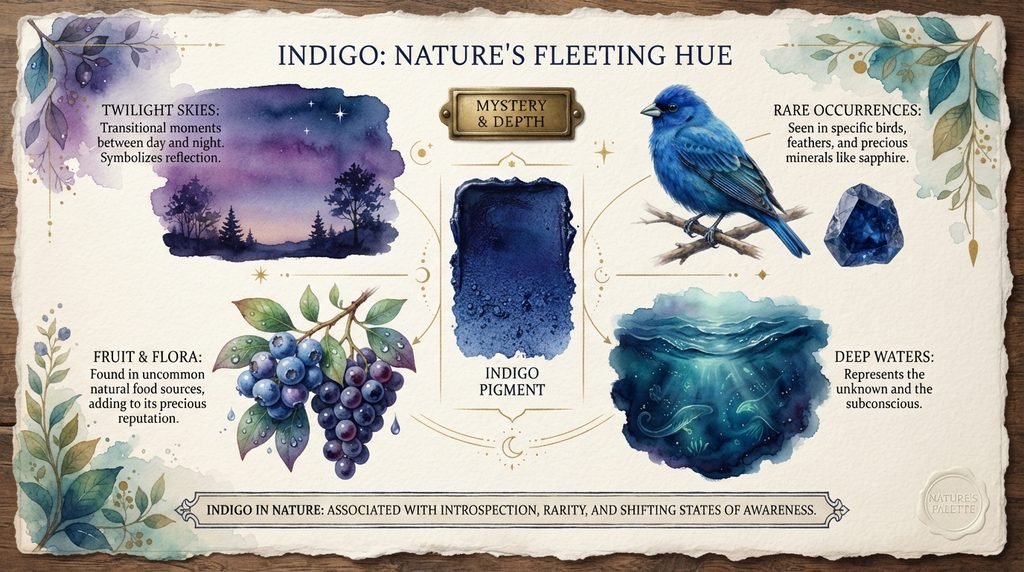
Looking at indigo in the wild helps explain why humans associate it with mystery and depth.
Where Indigo Appears in Nature
Indigo shows up in twilight skies, certain flowers, and specific minerals. It also appears in some berries, feathers, and deep ocean waters. These occurrences tend to feel rare compared to more common natural colors like green or brown.
Here are a few familiar examples:
- Twilight and pre-dawn skies
- Indigo buntings and certain butterflies
- Blueberries and dark grapes
- Deep ocean waters and some gemstones like sapphire
Symbolic Meaning of Indigo from Nature
Indigo in nature often signals transition. Twilight sits between day and night, a brief window symbolizing change and reflection. This natural transition likely reinforced indigo’s link to introspection and shifting states of awareness.
Indigo is also rare in common food sources compared to red or green hues. This rarity may add to its reputation as a special, almost precious color in both nature and culture.
Indigo Color Meaning in History
Indigo has a dramatic and sometimes difficult history tied to global trade. Its production shaped economies, labor systems, and fashion across centuries. Tracing indigo through time reveals both its value and its cost.
Historical Significance of Indigo
Indigo dye has been used for thousands of years, with evidence of its use dating back to ancient Egypt and the Indus Valley civilization. The plant-based dye was difficult to produce, which made it valuable across many trading cultures. Indigo became one of the most important dye commodities in global history.
By the colonial era, indigo had become a major cash crop, particularly in India under British colonial rule. This period brought significant profit to colonial powers but came at great human cost to laborers forced into its cultivation.
Indigo, Royalty, War, and Class
Indigo-dyed cloth became a marker of status in several regions due to its cost and labor-intensive production. Wealthy merchants and nobility in various cultures wore indigo garments to display affluence. Its deep, rich tone suited formal and ceremonial clothing.
Indigo’s role in colonial trade also tied it to conflict and resistance. In India, forced indigo cultivation led to significant unrest among farmers, culminating in organized protests against unfair labor practices in the early twentieth century.
Famous Historical Shifts in Indigo
The invention of synthetic indigo dye in the late 1800s by chemist Adolf von Baeyer dramatically changed the industry. This breakthrough made indigo far cheaper and more accessible, eventually leading to the decline of natural indigo farming in many regions. It also paved the way for indigo’s modern association with denim.
Blue jeans, dyed with indigo since their invention in the nineteenth century, turned this once-precious color into an everyday global staple. This shift shows how industrial innovation can completely transform a color’s cultural role.
Shades of Indigo and Their Meanings
Not all indigos feel the same. A soft blue-indigo feels calm, while a deep violet-indigo feels mysterious and intense. These subtle shifts change the entire mood indigo creates.
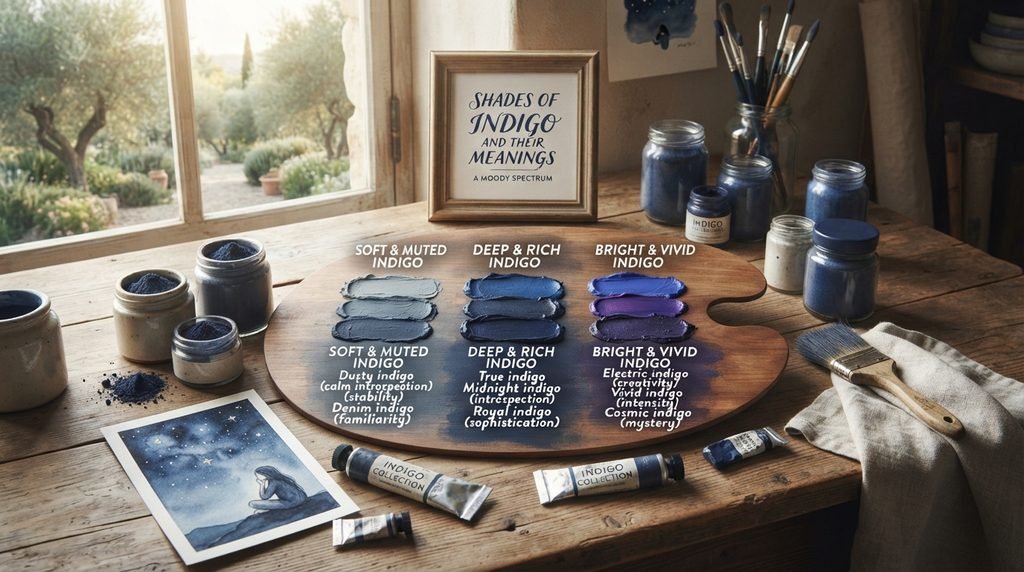
Here are the main families of indigo and what each tends to communicate.
Soft and Muted Indigo Shades
Softer indigos lean closer to blue and feel calm and approachable. They suggest quiet reflection rather than intensity. They are common in relaxed, contemplative design spaces.
- Dusty indigo: calm introspection and quiet focus
- Slate indigo: stability with a thoughtful edge
- Denim indigo: familiarity, comfort, and everyday depth
Deep and Rich Indigo Shades
Deeper indigos lean toward violet and feel intense and mysterious. They suggest seriousness and spiritual depth. They suit formal, ceremonial, or meditative contexts.
- True indigo: wisdom, mystery, and depth
- Midnight indigo: introspection and quiet intensity
- Royal indigo: sophistication with spiritual weight
Bright and Vivid Indigo Shades
Vivid indigos feel bold and striking while keeping their reflective nature. They add energy without losing depth. They are less common but appear in creative and artistic design.
- Electric indigo: creativity and bold insight
- Vivid indigo: intensity with imaginative energy
- Cosmic indigo: mystery paired with vibrant expression
Indigo Color Meaning in Branding & Marketing
Indigo is a less common but strategic choice for brands seeking depth and sophistication. It creates a sense of trust mixed with creativity. Choosing indigo sends a thoughtful, distinct signal to consumers.
Let’s look at why companies rely on indigo and what it communicates.
Why Brands Use Indigo in Logos
Indigo suggests reliability combined with imagination, blending blue’s trust with violet’s creativity. It helps brands feel both grounded and innovative. Technology and wellness brands often choose it to feel forward-thinking yet dependable.
Indigo also stands out from more common blue branding without feeling overly bold like red or purple. This balance makes indigo color psychology useful for brands wanting quiet distinction.
Famous Brands That Use Indigo
Several recognizable brands incorporate indigo into their identity. The color helps them feel sophisticated, trustworthy, and slightly distinctive. A few examples include:
- Yahoo
- NordVPN
- Slack (in earlier branding)
- Levi’s (through denim heritage)
What Indigo Communicates to Consumers
Indigo tells consumers a brand is thoughtful, trustworthy, and a little unconventional. It suggests depth without the aggression of darker, bolder colors. That is why it works well for tech, wellness, and creative industries. Brands wanting pure trust typically lean toward standard blue instead.
Indigo Color Meaning in Fashion & Design
Indigo is a versatile and enduring choice in both clothing and interior spaces. It can feel casual through denim or formal through deep fabric tones. Its range makes it a lasting favorite across design styles.

The key is choosing the right depth of indigo for the intended mood.
What Wearing Indigo Signifies
Wearing indigo often signals quiet confidence and thoughtful style. Denim indigo feels casual and dependable, while deep indigo fabrics feel formal and refined. Many people choose indigo for its versatility across both relaxed and polished occasions.
Indigo clothing can also suggest a reflective, independent personality. It avoids the boldness of brighter colors while still making a clear style statement.
Indigo Meaning in Interior Design
In interiors, indigo adds depth and sophistication without the heaviness of black. It works well in reading nooks, bedrooms, and spaces meant for focus or rest. Deep indigo walls can create a cozy, enveloping feeling when balanced with good lighting.
Too much dark indigo without contrast can feel cave-like or closed in. Designers often pair it with white, gold, or warm wood tones to keep spaces feeling open.
Style Tips for Using Indigo
Indigo offers a flexible middle ground between blue and purple design choices. A thoughtful amount adds richness without overwhelming a space or outfit. Try these simple ideas:
- Wear indigo denim as a versatile everyday staple
- Choose deep indigo fabrics for refined evening wear
- Pair indigo with gold accents for added warmth
- Use indigo as an accent wall rather than covering an entire room
Indigo Color Meaning and Personality
Many people feel a quiet pull toward indigo without fully knowing why. Color preference can offer a light, fun glimpse into personality traits. This is not a scientific test, but it remains a popular way to reflect on personal style.
Personality Traits of People Who Love Indigo
People who love indigo are often described as thoughtful and introspective. They tend to value depth over surface-level interaction. They may also carry a strong sense of intuition.
Common traits linked to indigo lovers include:
- Deep thinking and reflection
- Strong intuition
- A preference for meaningful connection
- Independence in thought and style
What Choosing Indigo as a Favorite Color Reveals
A favorite color of indigo may suggest someone who values wisdom over impulsiveness. They may prefer quiet reflection over constant social stimulation. They often trust their instincts when making decisions.
It can also point to a rich inner world that others may not immediately see. Indigo lovers may seem reserved at first but hold deep, considered perspectives. That hidden depth is part of indigo’s quiet charm.
Indigo Color Meaning in Dreams
Dream interpretations are personal, and no single meaning applies to everyone. Still, indigo often appears when the mind is processing intuition or deeper truths. It can show up as night skies, clothing, or a soft glow.
Here are common ways people read indigo in dreams.
Positive Meanings of Indigo in Dreams
Indigo can point to insight, wisdom, or a moment of clarity. A deep indigo sky or calm indigo light may reflect trust in your own instincts. It can suggest you are ready to listen more closely to your inner voice.
Some people see indigo in dreams as a sign of spiritual growth. It may hint that you are becoming more aware of patterns in your life.
Cautionary Meanings of Indigo in Dreams
Indigo can also point to isolation or overthinking. A dream filled with heavy, dark indigo might suggest you are withdrawing too much from others. It may be a nudge to balance reflection with connection.
Indigo can also hint at unresolved confusion. If a dream feels murky or unclear, it may reflect uncertainty about a decision. Pay attention to how the dream made you feel.
Indigo Color Meaning in Astrology, Tarot & Numerology
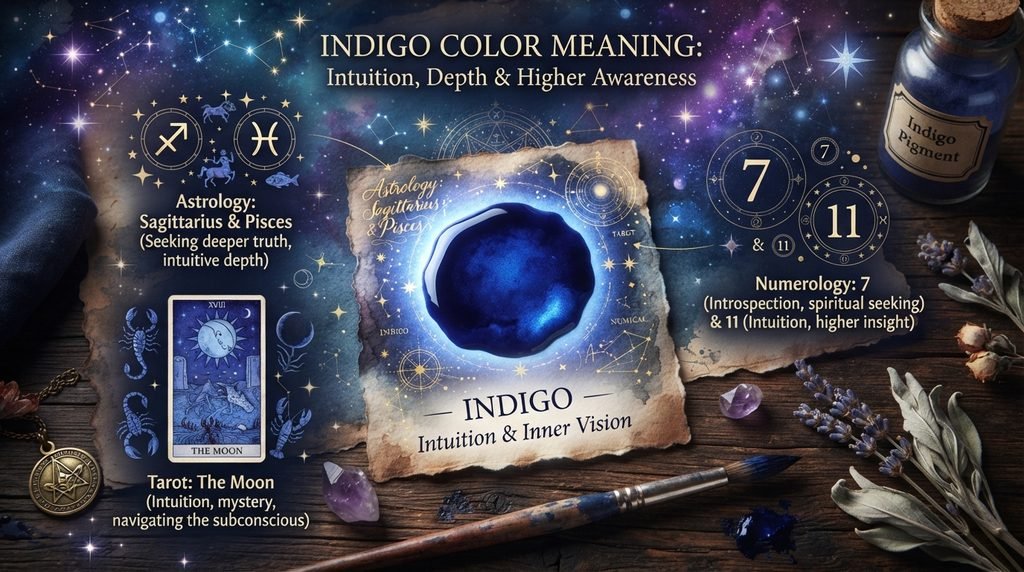
Indigo appears in several mystical systems tied to intuition and higher awareness. It is linked to insight, depth, and inner vision. Keep in mind these are belief-based traditions, and sources may vary.
Indigo and Zodiac Signs
Indigo is often linked to Sagittarius and Pisces, both known for seeking deeper truth and meaning. Sagittarius’s philosophical nature and Pisces’s intuitive depth both align with indigo’s reflective energy. Scorpio is sometimes included too, given its connection to hidden insight.
These associations tie indigo closely to themes of wisdom and inner exploration across astrology.
Indigo in Tarot Symbolism
Indigo appears in tarot art tied to intuition, mystery, and inner knowledge. The Moon card, representing intuition and the subconscious, often features deep indigo tones. It suggests navigating uncertainty through instinct rather than logic.
Indigo skies and deep backgrounds also appear on cards related to spiritual insight. In tarot, indigo often signals a call to trust inner wisdom.
Indigo in Numerology
Numerology does not have one universally agreed color system. Some sources link indigo to the number 7, associated with introspection and spiritual seeking. Others connect it to the number 11, tied to intuition and higher insight.
Because sources differ, treat these links as a matter of personal interpretation.
Interesting Facts & Trivia About the Meaning of Indigo
Indigo carries several surprising stories tied to science and culture. These facts highlight how much history this often-overlooked color holds.
Surprising Science Facts About Indigo
Indigo sits between blue and violet on the visible spectrum, but many people struggle to perceive it as a distinct color. Some researchers suggest Isaac Newton included indigo in his seven-color rainbow partly due to a numerical preference for the number seven. This has led to ongoing debate about whether indigo deserves its own spot in the spectrum.
Natural indigo dye comes from fermenting leaves of the indigo plant, a process that produces no blue color until the fabric is exposed to air. This oxidation reaction is part of why indigo dyeing has long been considered a specialized craft.
Surprising Cultural Facts About Indigo
Indigo was once called “blue gold” due to its high value during peak trade periods. Entire economies in parts of Asia and the Americas depended heavily on its production and export. This nickname reflects just how prized the color once was.
The deep indigo color of traditional denim actually fades over time because the dye does not fully penetrate the cotton fibers. This is why well-worn jeans develop lighter, unique patterns through repeated use and washing.
Frequently Asked Questions About
These are common questions people search for about indigo. Each answer stays short and clear.
What does the color indigo mean spiritually?
Spiritually, indigo represents intuition, insight, and connection to inner wisdom. It is linked to the third eye chakra in many spiritual traditions. It encourages trust in instinct and deeper perception.
What does indigo symbolize in general?
Indigo symbolizes depth, intuition, wisdom, and introspection. It can also suggest isolation or heaviness in certain contexts. Its exact meaning shifts with shade and setting.
What is indigo color psychology in simple terms?
Indigo color psychology suggests this shade feels reflective and mentally focused. It can support deep thinking and calm introspection. Too much indigo, however, can feel somber or distant.
Why do brands use indigo in their logos?
Brands use indigo to feel trustworthy yet creative and distinct. It blends blue’s reliability with a touch of violet’s imagination. It works especially well for tech and wellness-focused products.
Is indigo the same as blue or purple?
Indigo sits between blue and purple on the color spectrum, sharing qualities of both. It leans closer to blue but carries more depth and mystery. Many people find it difficult to distinguish from its neighboring colors.
What does indigo mean in a dream?
Indigo in a dream often points to intuition, insight, or spiritual reflection. It can also suggest isolation or confusion depending on the dream’s tone. The surrounding details and your feelings matter most.
Conclusion:
Indigo color meaning rests in the space between clarity and mystery. It carries wisdom and introspection, trade history and spiritual depth, often within the same quiet shade. Few colors blend the practical and the mystical quite the way indigo does.
From ancient dye trade routes to modern denim and meditation spaces, indigo has always invited a second look. Its strength lies in rewarding reflection rather than demanding attention. The next time you notice indigo around you, pause and consider what deeper thought it might invite.