

Red is hard to ignore. It sits on stop signs, fire trucks, and lipstick. It fills Valentine’s Day, festival banners, and warning labels. Few colors show up in so many parts of daily life.
The meaning of red is just as wide. It can point to love, courage, and celebration. It can also point to anger, danger, and alarm. That mix is what makes the meaning of the color red so interesting to explore.
This guide covers the full picture. You will learn what red symbolizes, how red color psychology shapes mood, and how cultures and religions read this shade. You will also see red in nature, history, branding, fashion, dreams, and astrology.
General Red Color Meaning & Symbolism
Red is the color of strong feeling. It rarely sits quietly in the background. People tend to react to it quickly, and often without thinking.
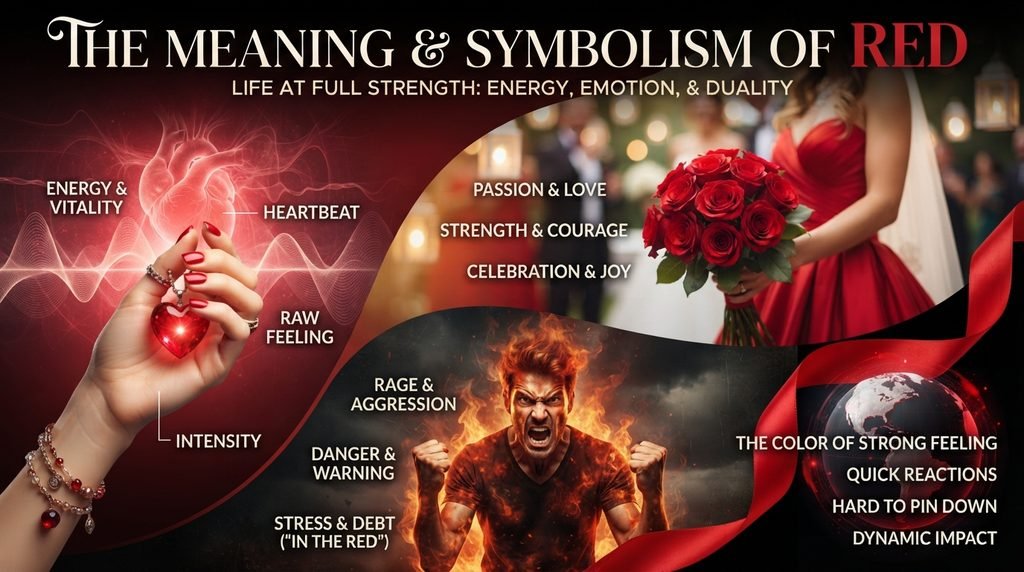
When people ask what red symbolizes, the answer is usually “intensity.” Red raises the volume of whatever it touches. A red rose feels more romantic, and a red alert feels more urgent.
Core Psychological Associations of Red
The core meaning of the color red is tied to energy and emotion. Red is linked to the body, the heartbeat, and raw feeling. It feels alive, warm, and direct.
Most people connect red with a few main ideas:
- Passion and desire
- Strength and courage
- Urgency and alertness
- Anger and warning
Positive Meanings of Red
At its best, red stands for love, vitality, and bravery. It gives a sense of drive. It can make a person feel bold and ready to act.
Red also stands for celebration in many places. It shows up at weddings, festivals, and victory parades. In these settings, the meaning of the color red is joyful and full of life.
Negative Meanings of Red
Red has a darker side too. It can signal rage, aggression, and danger. Phrases like “seeing red” show how closely it is tied to anger.
Red can also suggest debt, as in “in the red.” Too much red in a space can feel loud or stressful. The meaning of red depends on how much is used and where.
What Red Represents Overall
Red represents life at full strength. It covers both the sweetest and the sharpest human feelings. That is why it is so hard to pin down with one word.
Red Color Psychology: How the Color Affects Mind and Body
Red color psychology looks at how this shade changes the way people think and act. Researchers have studied it in classrooms, sports, shops, and homes. Some results are clear, while others are still debated.
What we can say is that red gets noticed. It tends to trigger quick emotional responses. Let’s look at how.
Red Color Psychology and Mood
Red can lift energy and make a moment feel more urgent. It often pushes people toward quick, instinctive choices. That is why it works well on sale tags and buttons.
Red can also stir up competitive feelings. In some studies, seeing red before a test made people more cautious and less confident. So red can motivate in one setting and add pressure in another.
Red and the Brain and Nervous System
Many writers claim red speeds up the heart and raises blood pressure. The evidence for this is mixed, so it is safer to say red may raise alertness. Its strong effect on attention is much better supported.
Red is also the longest wavelength we can see. Because of this, it stands out clearly at a distance and in poor light. This helps explain why brake lights and warning signs are red.
For contrast, blue leans toward calm and trust. Red does the opposite by pulling you in and asking for a response.
Why Humans React Strongly to Red
Human reactions to red likely have deep roots. Blood, fire, and ripe fruit are all red. Early humans needed to notice these things fast.
Over time, red became linked to both survival and risk. It could mean food, warmth, or injury. That double message still lives in how we feel about red today.
Red Color Meaning in Different Cultures
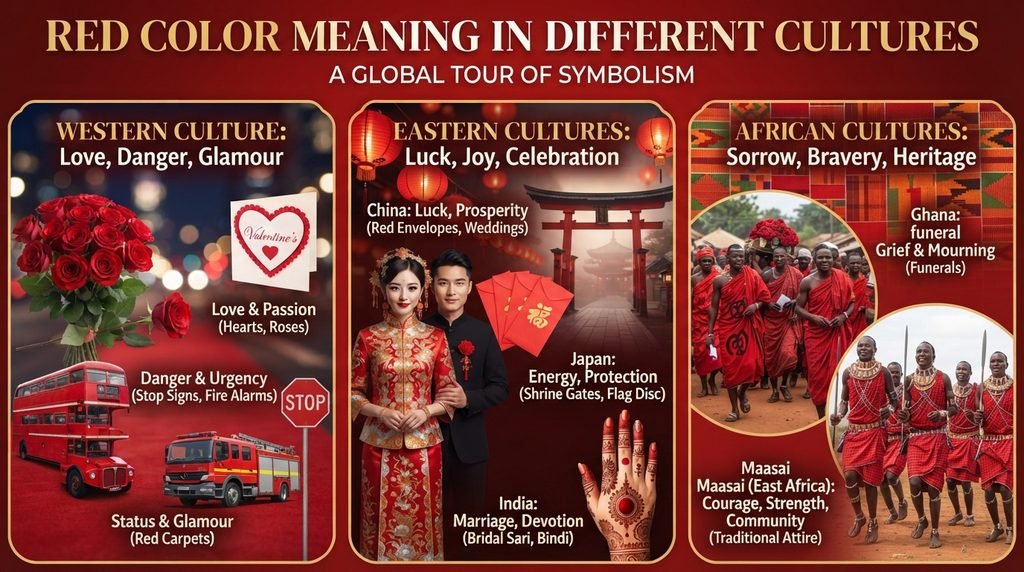
Red color meaning changes from place to place. A shade that feels lucky in one country may feel serious in another. Still, most cultures treat red as a color of importance. Below is a tour of how red is understood around the world. Keep in mind that every region holds many traditions, so these are broad patterns.
[Image: A collage of red lanterns, a red bridal sari, and a red flag. Caption: The meaning of red shifts across borders, but its power does not.]
Red Meaning in Western Culture
In Western countries, red often stands for love and danger at the same time. Hearts, roses, and Valentine’s Day cards are all red. So are stop signs, fire alarms, and emergency vehicles.
Red also signals status and glamour. Think of the red carpet at film premieres. It marks a moment as special.
Red Meaning in Eastern Cultures
In many parts of Asia, red is a color of good fortune and joy. It often appears at times of new beginnings. Here are a few examples:
- China: Red means luck, happiness, and prosperity. Families give red envelopes with money at Lunar New Year and weddings.
- Japan: Red is tied to energy and protection. It appears in shrine gates and in the red disc on the national flag.
- India: Red is strongly linked to marriage, fertility, and devotion. Brides often wear red, and married women may wear a red mark in the hair parting.
Across these traditions, red is a welcome color. It is seen as protective and full of blessing.
Red Meaning in African Cultures
Red carries deep meaning across Africa, and the message varies by region. In Ghana, for example, red is often worn at funerals. There, it expresses grief and strong emotion instead of joy.
Among the Maasai of East Africa, red is a key color in clothing. It is linked to courage, strength, and community pride. This shows how one color can carry both sorrow and bravery in different places.
Red Meaning in Middle Eastern Cultures
Red has a rich place in the art and daily life of the Middle East. Persian carpets often use deep reds as a base color. These reds suggest warmth, richness, and hospitality.
Red also appears on many national flags in the region. There,e it often stands for courage, sacrifice, and pride in history. It is less a color of romance and more a color of strength and heritage.
Red Meaning in Latin American Cultures
In Latin America, red is a color of passion and celebration. It shows up in festivals, dance costumes, and street decorations. It fits the warm, expressive spirit of many local traditions.
Red also has symbolic roles. A red string or bracelet is worn in some communities for protection. Red on national flags is often read as a sign of bravery and the sacrifice of heroes.
Cultural Contrasts in Red Color Meaning
The biggest contrast is between weddings. In China and India, red is the classic bridal color. In much of the West, white has long been the traditional choice.
Another contrast is joy versus grief. Red brings luck in China but marks mourning in parts of Ghana. These differences show that color meaning is learned, not fixed.
Red Meaning in Religion & Spirituality
Red plays a big part in faith and ritual. Religions often use it to speak about life, sacrifice, and divine power. Its strong pull on the eyes makes it ideal for sacred moments.
Different traditions use it in different ways. Here is what red symbolizes in several of them.
Red in Christianity
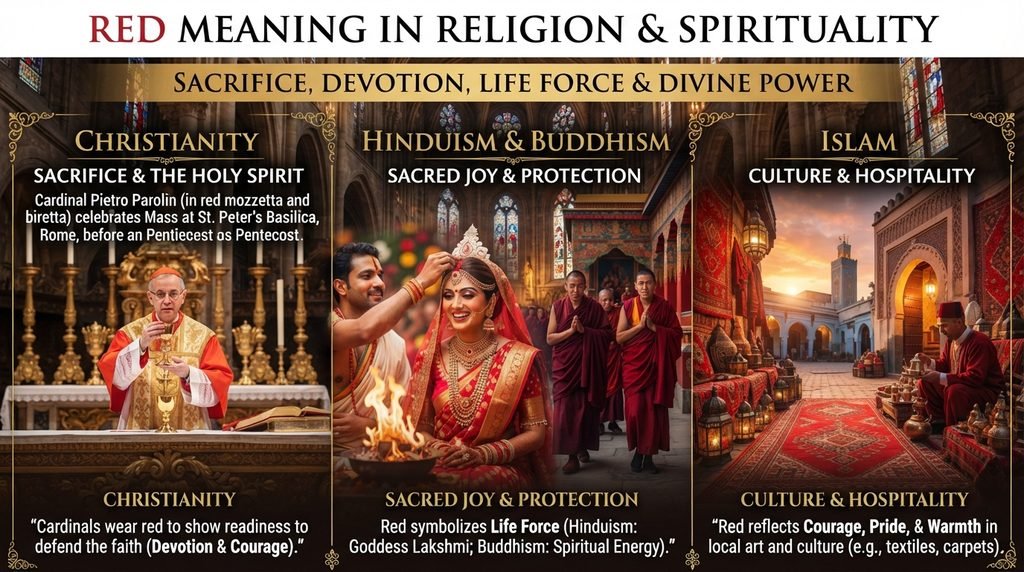
In Christian tradition, red is tied to sacrifice and the Holy Spirit. Church leaders wear red on days that honor martyrs. They also wear it at Pentecost, which celebrates the Spirit’s arrival.
Cardinals wear red to show their readiness to defend the faith. In this setting, the meaning of red blends devotion with courage.
Red in Hinduism and Buddhism
In Hinduism, red is a sacred and joyful color. It is linked to goddesses such as Lakshmi and Durga. Red powder and red cloth appear in many rituals and weddings.
In Buddhism, red is linked to life force and protection. Monks in Tibetan traditions wear deep maroon and red robes. There, the color reflects strength and spiritual energy.
Red in Islam
Red is not a central sacred symbol in Islam the way green is. Its meaning comes more from culture and local art. It appears in carpets, textiles, and flags across Muslim-majority regions.
In those settings, red often points to courage, pride, and warmth. Its role is decorative and cultural more than doctrinal.
Red in Other Spiritual Traditions
Many folk and mystical traditions use red for protection. A red thread worn on the wrist is a well-known example. It is believed by many to guard against bad luck and envy.
Red also appears in old rituals about blood, fire, and rebirth. In these settings, it stands for the force that keeps life moving.
Red Chakra and Aura Meaning
In chakra teaching, red belongs to the root chakra. This energy center is tied to safety, stability, and survival. A balanced root chakra is said to bring a grounded feeling.
In aura reading, a red aura is often linked to strong will and vitality. Believers describe such people as driven and full of action. These ideas come from spiritual practice, not from scientific testing.
Red Color Meaning in Nature
Nature uses red all the time, and often with a purpose. Some reds attract, while others warn. That is one reason red color meaning feels so natural to us.
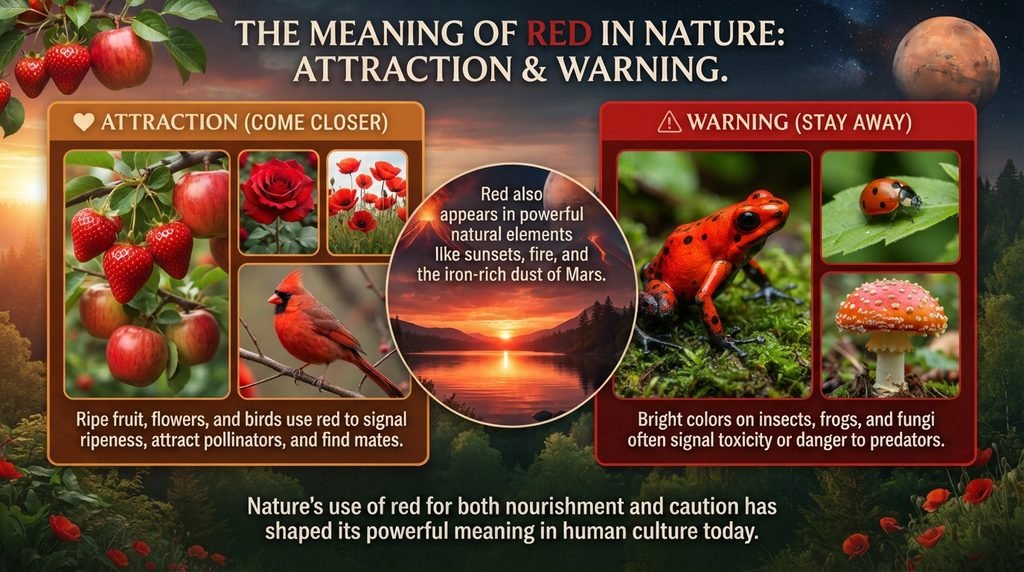
Looking at red in the wild helps explain why humans read it as both inviting and dangerous.
Where Red Appears in Nature
Red shows up in many living things and landscapes. You can spot it in flowers, birds, insects, and fruit. Ripe strawberries, apples, and tomatoes are all red.
Here are a few familiar examples:
- Poppies and roses
- Cardinals and ladybugs
- Autumn maple leaves
- Sunsets and lava
- Mars, the “red planet,” colored by iron-rich dust
Symbolic Meaning of Red from Nature
Red in nature works as a signal. Bright red fruit says “I’m ripe and ready.” Bright red on some frogs and insects says “stay away, I’m toxic.”
Those two messages shaped human symbolism. Red became a sign of nourishment and a sign of caution. That is exactly the double meaning we see in culture today.
Red Color Meaning in History
Red has been part of human life for a very long time. People used it in art, rituals, and power long before written history. Its story is tied to both beauty and control.
Following red through history shows why it became such a strong symbol of status and struggle.
Historical Significance of Red
Early humans used red ochre, a natural earth pigment, in cave art and burial rituals. It is one of the oldest colors humans ever worked with. Red seems to have mattered from the start.
Later, strong red dyes were costly and hard to make. Cochineal, a dye made from tiny insects, was prized in the Americas and later traded across the world. Owning red cloth often meant owning wealth.
Red, Royalty, War, and Politics
Red became a color of rulers and armies. Ancient Roman generals painted themselves red during victory parades. European courts used red robes and even red-heeled shoes to show rank.
Red was also chosen for soldiers’ uniforms, like the British “redcoats.” On the political side, red flags became symbols of revolt and reform. In the 1900s, many socialist and communist movements adopted red as their emblem.
Famous Moments Tied to Red
The red carpet has an ancient literary link. A Greek play from the fifth century BC shows a king walking on crimson fabric, a sign of great honor and risk. That image lives on in modern award shows.
In the 1860s, the Red Cross adopted its emblem to protect medical workers in war. The red cross turned red into a symbol of care as well as conflict.
Shades of Red and Their Meanings
Not all reds feel the same. A bright red can shout, while a dark red can whisper. Small changes in tone shift the whole mood.
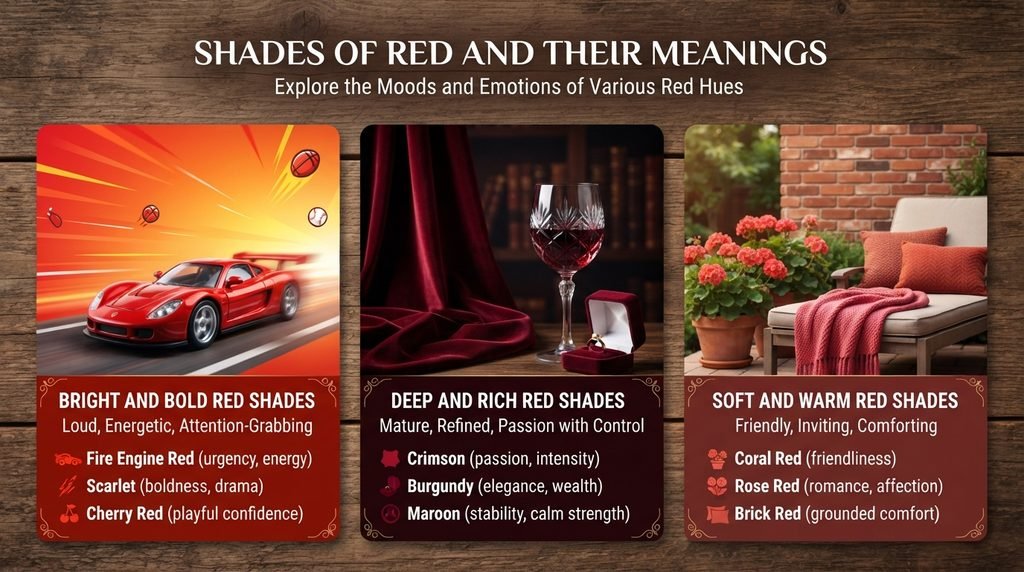
Here are the main families of red and what each one tends to communicate.
Bright and Bold Red Shades
Bright reds are the loudest and most energetic. They grab attention and push people to act. They are common in sports, sales, and safety signs.
- Fire engine red: urgency, energy, alertness
- Scarlet: boldness, drama, rebellion
- Cherry red: playful confidence and fun
Deep and Rich Red Shades
Dark reds feel more mature and refined. They still carry passion, but with more control. They suit formal settings and luxury goods.
- Crimson: deep passion and intensity
- Burgundy: elegance, wealth, and sophistication
- Maroon: stability, seriousness, and calm strength
Soft and Warm Red Shades
Softer reds blend red with orange, pink, or brown. They feel friendlier and less demanding. They invite warmth without pressure.
- Coral red: friendliness and approachability
- Rose red: romance and affection
- Brick red: grounded, earthy comfort
Red Color Meaning in Branding & Marketing
Red is one of the most popular colors in business. Brands choose it because it works fast. It catches the eye in a crowded space.
Let’s look at why companies rely on red and what message it sends to buyers.
Why Brands Use Red in Logos
Red creates instant attention. On a busy shelf or a crowded screen, it stands out. It also adds a sense of speed and action.
Food brands like red because it is often linked with appetite. Retail brands like it because it feels urgent. This is why red color psychology is a favorite tool in advertising.
Famous Brands That Use Red
Many well-known logos are built on red. The color helps them feel bold and easy to remember. A few examples include:
- Coca-Cola
- Netflix
- YouTube
- Target
- Red Bull
- Ferrari
What Red Communicates to Consumers
Red tells customers that something is exciting, important, or time-sensitive. It suggests energy and confidence. That is why clearance signs are so often red.
It can also suggest power and speed, which fits sports cars and energy drinks. Brands that want calm and trust usually pick blue instead.
Red Color Meaning in Fashion & Design
Red is a statement in both clothing and home decor. It rarely blends in. Used well, it adds confidence and life to a look or a room.
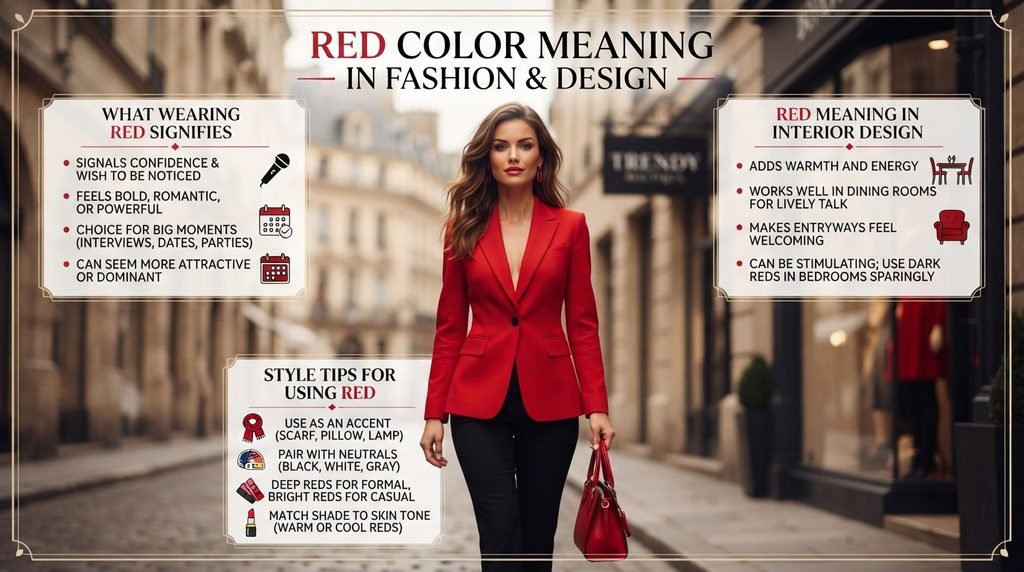
The key is knowing how much red to use and where.
What Wearing Red Signifies
Wearing red often signals confidence and a wish to be noticed. It can feel bold, romantic, or powerful. Many people choose it for big moments, like interviews, dates, and parties.
Some studies suggest red can make people seem more attractive or dominant. Results are not always consistent. Still, red clearly gets attention.
Red Meaning in Interior Design
In interiors, red adds warmth and energy. It works well in dining rooms, where it supports lively talk. It can also make a small entryway feel welcoming.
Bedrooms are trickier, since red can feel stimulating instead of restful. If you love it there, use dark, softer reds in small amounts.
Style Tips for Using Red
You do not need a full red outfit or room to feel its effect. A little goes a long way. Try these simple ideas:
- Use red as an accent, like a scarf, pillow, or lamp
- Pair red with neutrals such as black, white, or gray
- Choose deep reds for formal events and bright reds for casual fun
- Match your shade to your skin tone by trying warm or cool reds
Red Color Meaning and Personality
Many people feel a strong bond with red. They may not know why, but it just feels right. Color preference can offer a light look at personality.
Keep in mind that this is a fun guide, not a scientific test.
Personality Traits of People Who Love Red
People who love red are often described as energetic and outgoing. They tend to be confident and quick to act. They may also be competitive.
Common traits linked to red lovers include:
- Passion and drive
- Assertiveness
- Warmth and enthusiasm
- A love of being active
What Choosing Red as a Favorite Color Reveals
A favorite color of red may suggest someone who likes momentum. They may prefer action over waiting. They often enjoy being in the middle of things.
It can also point to a strong emotional life. Red lovers may feel deeply, both the highs and the lows. That depth is part of red’s charm.
Red Color Meaning in Dreams
Dream meanings are personal, and no single answer fits everyone. Still, red often appears when emotions are running high. It can show up as an object, a light, or a whole scene.
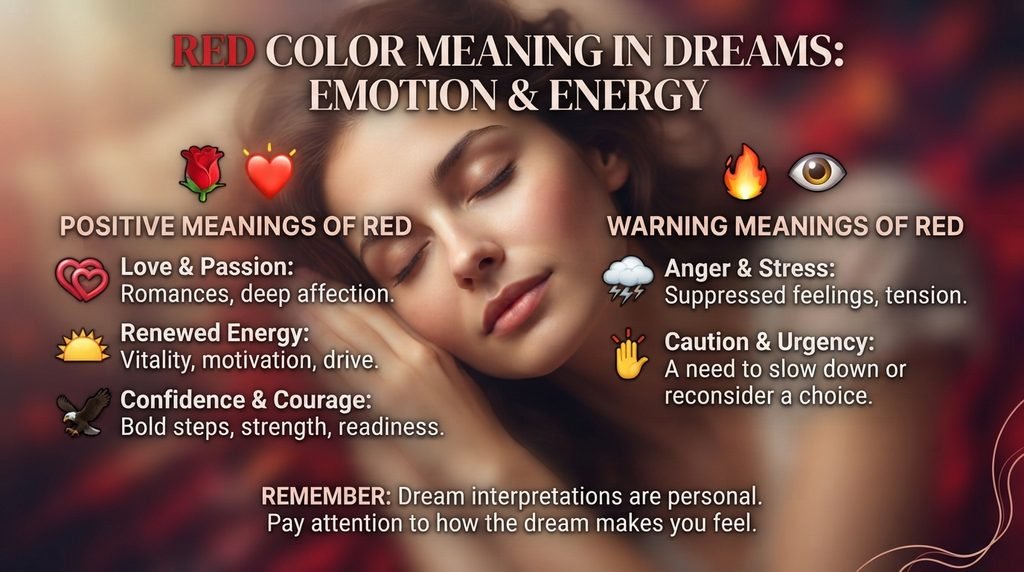
Here are the common ways people read red in dreams.
Positive Meanings of Red in Dreams
Red can point to love, passion, or renewed energy. A red rose or red dress may reflect romance or confidence. It can also suggest new drive in your waking life.
Some people see red in dreams as a sign of courage. It may hint that you are ready to take a bold step.
Warning Meanings of Red in Dreams
Red can also stand for anger or stress. A blazing red sky might reflect feelings you are holding in. It may be your mind’s way of asking you to slow down.
Red can act as a caution too. If a dream feels tense, it may point to a choice you are unsure about. Pay attention to how the dream made you feel.
Red Color Meaning in Astrology, Tarot & Numerology
Red plays a big part in many mystical systems. It is linked to fire, action, and will. Keep in mind these are belief-based traditions, and different sources may disagree.
Here is how red is commonly used in each.
Red and Zodiac Signs
Red is most often linked to Aries and Scorpio. Both signs are tied to Mars, the planet of drive and action. Aries is known for bold starts, and Scorpio for deep intensity.
Leo is sometimes linked to red as well, thanks to its fiery nature. The link is loose but common.
Red in Tarot Symbolism
Red appears often in tarot art. It usually stands for passion, power, and will. The Emperor card, for instance, is full of red and represents authority.
Red flowers and robes also appear on cards about action and desire. In tarot, red says “something is happening.”
Red in Numerology
Numerology has no single agreed system for colors. Some sources link red to the number 1, which stands for leadership and fresh starts. Others link it to the number 9, tied to Mars-like courage.
Because sources differ, treat this as a matter of personal meaning.
Interesting Facts & Trivia About the Meaning of Red
Red has plenty of surprising stories behind it. Some come from science, while others come from culture. These facts show how much this color has shaped human life.
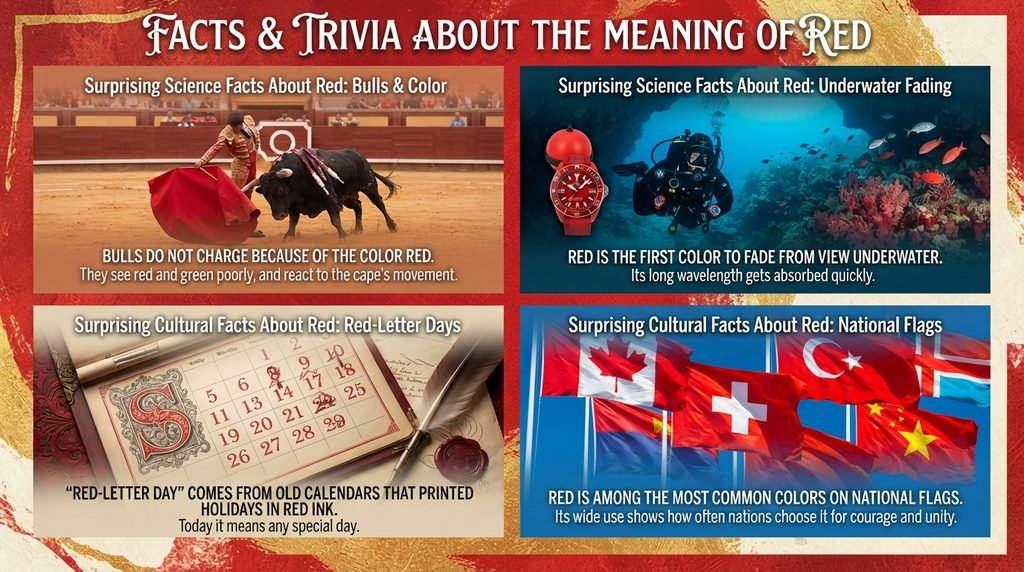
Surprising Science Facts About Red
Bulls do not charge because of the color red. They see red and green poorly, and they react to the cape’s movement. The color is mostly for the audience.
Red is also the first color to fade from view underwater. Its long wavelength gets absorbed quickly. That is why deep-sea scenes look blue and green.
Surprising Cultural Facts About Red
The phrase “red-letter day” comes from old calendars that printed holidays in red ink. Today it means any special day. It is a small trace of red’s link to importance.
Red is also among the most common colors on national flags. Its wide use shows how often nations choose it for courage and unity.
Frequently Asked Questions About Red Color Meaning
These are the questions people search most often about red. Each answer is short and clear.
What does the color red mean spiritually?
Spiritually, red stands for life force, courage, and grounding. In chakra teaching, it belongs to the root chakra. It is tied to feeling safe and rooted.
What does red symbolize in general?
Red symbolizes love, passion, energy, and danger. It is a color of strong emotion. Its meaning depends on context and culture.
What is red color psychology in simple terms?
Red color psychology says red grabs attention and stirs feelings. It can raise energy and urgency. Research on some effects is still mixed.
Why do brands use red in their logos?
Brands use red because it stands out fast. It suggests energy, excitement, and action. It also works well for food and sales.
Is red a lucky color?
In China and many parts of Asia, red is very lucky. It is used at weddings and festivals. In other cultures, luck is not its main meaning.
What does red mean in a dream?
Red in a dream often points to strong emotion. It may mean love, anger, or a call to act. The details and your feelings matter most.
Conclusion
Red color meaning is rich and layered. It carries love and anger, courage and caution, luck and loss. Few colors hold so many messages at once.
From ancient cave art to modern logos, red has always been used to say something important. Its power comes from how directly it speaks to our instincts. When you next see red, ask what it is trying to tell you.