
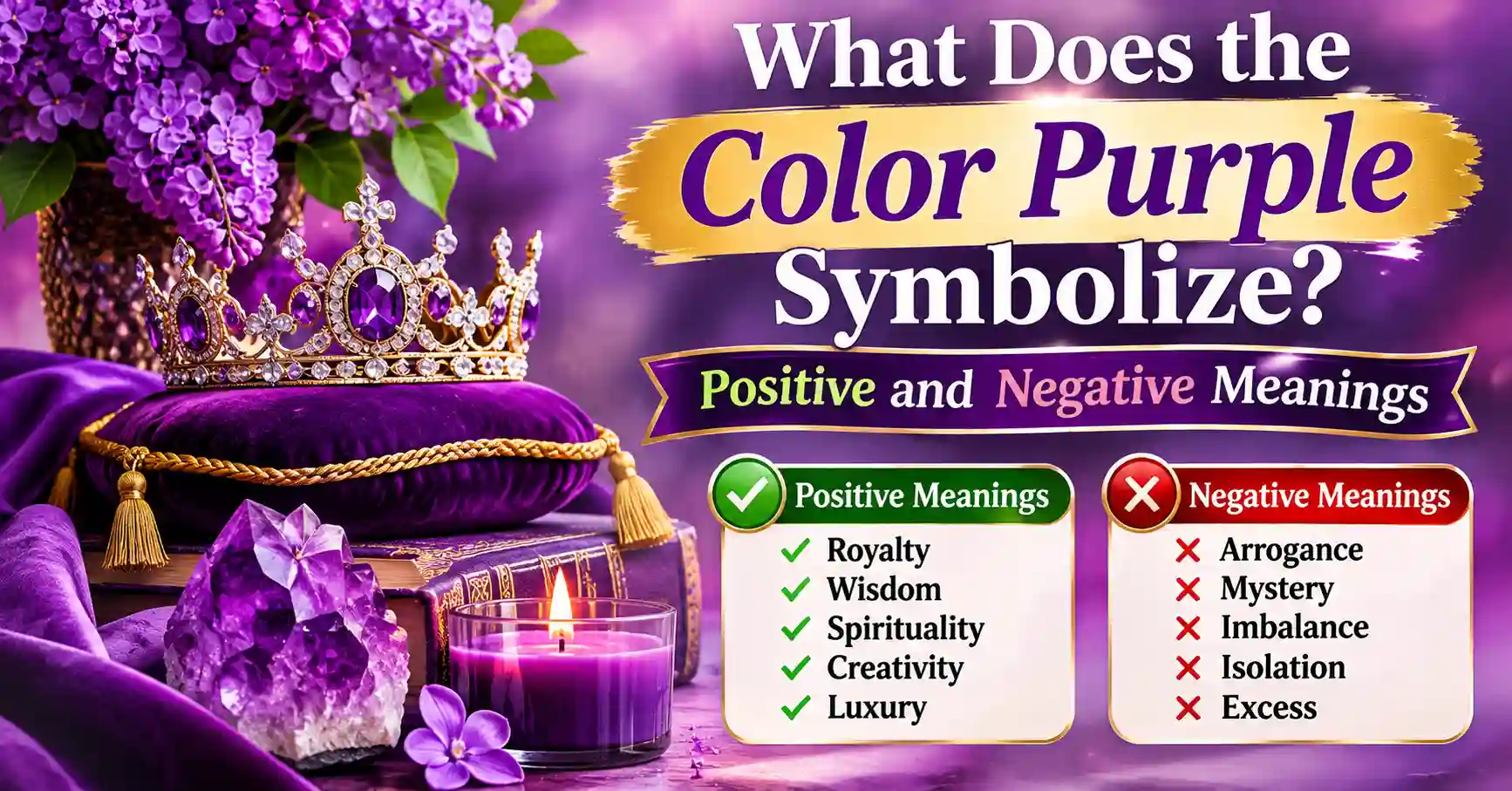

Quick Answer: What does the color purple symbolize? Purple stands for royalty, spirituality, mystery, and creativity. It grew from the high cost of ancient purple dye, which only rulers could afford. It can also suggest mourning, arrogance, or excess, depending on the culture and the setting.
Go for a walk and count the purple things you see. You will find a few flowers, maybe a plum, and not much else. Purple is oddly scarce in the natural world. So what does the color purple symbolize, and why does something so rare carry so much weight? The answer is a mix of money, faith, and mystery. In this guide, we will look at both the bright side and the shadow side of purple symbolism. You will see why one shade can crown a king and also mark a funeral.
What Does the Color Purple Symbolize? The Short Version
Purple symbolizes things that feel special, set apart, or hard to explain. Most often, that means royalty, spirit, imagination, and mystery. It also carries a darker set of meanings, such as pride, grief, and excess. Two ideas explain most of this: where purple sits on the color wheel, and how hard it once was to make.
Where Warm Meets Cool
Purple is a blend. It sits between red and blue, and it borrows from both. Red brings heat, action, and feeling. Blue brings distance, depth, and calm. Purple holds both at once, which is why it often feels like a color of balance or tension. It is neither fully hot nor fully cool, and that in-between quality gives it a dreamy, hard-to-pin-down feel.
Rare by Nature, Rich in Meaning
For most of history, people could not easily find or make a strong purple. Many everyday plants and minerals gave reds, yellows, and browns. Purple was far harder to get. Whatever is rare tends to become precious, and whatever is precious tends to become a symbol. Much of the symbolism of purple grows from this one fact.
Read More: Lavender Color Meaning: Symbolism, Psychology & Spiritual Significance
Purple and Power: The Color of Crowns
If you ask where purple got its royal reputation, one story stands above the rest. In the ancient Mediterranean, a famous purple dye came from sea snails. Making it took huge effort and a huge number of snails. The result was a deep, lasting color that cost a fortune. Only the very rich could wear it, and in many places only rulers were allowed to.
The Dye That Cost a Fortune
The dye is often called Tyrian purple, after the coastal city of Tyre. Workers had to collect the snails, extract a tiny amount of fluid from each, and process it with care. Fabric dyed this way was prized because it did not fade easily. A purple cloak announced that its owner had money to spare. Wearing it was a public statement, with no words needed.
Born to the Purple
This history left a lasting mark on language. In some European traditions, a child born to a ruling family was said to be “born to the purple.” The phrase meant a person was born into rank, not earned it. Several empires also wrote rules about who could wear purple. Those rules turned a shade of cloth into a legal and social boundary. Even today, we still say “royal purple” without thinking about snails at all.
Sacred Purple: Faith, Spirit, and the Unseen
Purple also lives in worship and spiritual practice. Here it tends to mean something quieter than wealth. It points to reflection, longing, and the space between the earthly and the divine. Many traditions use it for moments of preparation, patience, and inner turning. The meaning differs by faith, so it helps to look at a few examples one at a time.
Purple in Christian Seasons
In many Christian churches, purple is the color of Lent and Advent. These are seasons of waiting and preparation. Purple fits because it feels serious but not harsh. It suggests humility and repentance, and it also suggests the dignity of a king who is expected. So the same color carries both sorrow and anticipation. Not every church follows the same custom, but the pattern is common.
The Crown Chakra and Amethyst
In the chakra tradition, violet or purple is often linked with the crown chakra. This center is tied to awareness, insight, and a sense of connection to something larger than oneself. The amethyst crystal, with its violet glow, is a popular stone in spiritual practice. In ancient Greek stories, it was linked with staying clear-headed rather than drunk. These ideas come from folklore and belief, not from science, but they show how purple became tied to the mind and the spirit.
Image caption: Amethyst is one of the best-known stones linked with calm and spiritual focus.
Mystery, Magic, and Imagination
Purple is also the color of things we cannot quite see. Twilight turns the sky purple just before dark. Storm clouds can look purple at the edge. This habit of showing up at moments of change has helped purple become a color of the unknown. Storytellers have used it for centuries to hint that something strange is nearby.
Wizards, Dreams, and Twilight
Think of how often stage magicians, fortune tellers, and fantasy wizards wear purple. The choice is not an accident. Purple feels like a secret, as if the wearer knows something you do not. Twilight adds to this feeling because it is neither day nor night. In many stories, purple marks a threshold, the moment when ordinary rules start to bend.
Art, Invention, and the Original Mauve
Purple is also tied to creativity and fresh ideas. Artists often use it to suggest feelings that words cannot hold. In the mid-1800s, a young chemist trying to make something else accidentally created the first widely used synthetic purple dye. The shade became a fashion craze, and purple slowly moved from a royal privilege to a color anyone could wear. That story shows how invention can change the meaning of a color. What was once a sign of rank became a sign of play and personal style.
Explore more ideas: Indigo Color Meaning: A Complete Guide to Indigo Symbolism & Psychology
Honor, Courage, and Causes
Purple does not only stand for rank or mystery. In modern times, it has also come to stand for honor and for movements that ask people to care. Here, the color is no longer about who can afford it. It is about what people choose to stand behind. These uses are newer, but they carry real weight.
Medals and Remembrance
In the United States, the Purple Heart is a military medal given to those wounded or killed in service. Its name and color tie the old sense of dignity to the idea of sacrifice. Wearing it signals that the person gave something real. In this setting, purple means respect more than luxury. It shows how the same color can move from a king’s robe to a soldier’s chest.
Suffrage and Awareness
In the early twentieth century, many women’s suffrage campaigners in Britain used purple together with white and green. Purple was commonly explained as standing for dignity and loyalty to the cause. Later, purple ribbons and clothing were taken up by various awareness campaigns, often connected to health and social issues. Lavender has also been used in some LGBTQ+ histories as a quiet sign of identity and solidarity. In each case, purple works as a banner of belonging.
The Shadow Side of Purple
Every strong symbol has a flip side, and purple is no exception. Its link to wealth and rank can slide into vanity. Its link to mystery can slide into suspicion. And in some places, it is tied to grief. Knowing these darker meanings helps you read purple more honestly.
Pride, Excess, and “Purple Prose”
Because purple once marked the very rich, it can also suggest showing off. A room packed with purple velvet and gold may read as grand, or it may read as too much. In writing, the phrase “purple prose” describes language that is overdone and flowery. The color stands in for anything that tries too hard to impress. Used wisely, purple signals class. Used carelessly, it signals excess.
Mourning and Melancholy
In several places, purple is a color of grief. Brazil is often named as one example, where purple has been tied to mourning customs. In parts of Europe, purple was historically worn by those in half-mourning, the stage after deep black. In Thailand, some widows have traditionally worn purple. These customs show that purple can carry sorrow and dignity side by side. It is a gentle way to say that loss is serious.
Purple Around the World
So what does the color purple represent from one culture to the next? It depends on history and trade. Where purple dye was rare, it became noble. Where other colors held that role, purple took on different jobs. Because customs shift by region, family, and era, treat these examples as patterns, not rules.
Nobility in Europe and Japan
In Europe, purple became tied to emperors, bishops, and royal courts. In Japan, purple also has a long link with high rank and refinement. Court culture there treated deep purple as a color of elegance. The two regions developed these ideas separately, yet they reached a similar place. In both, purple said that its wearer stood near the top.
Mixed Meanings Elsewhere
In parts of Latin America, purple is linked with religious processions and with mourning. In some Middle Eastern and South Asian settings, purple has been seen as a color of wealth or beauty, though the details vary widely. No single reading fits every place. A good habit is to ask what a community itself says purple means.
Shades of Purple and What They Suggest
The word “purple” covers a wide family. A pale shade feels soft and light. A deep one feels heavy and formal. The symbolism often shifts with the tone, and the shade you choose can quietly change the message. Here are some common shades and what they tend to suggest:
- Lavender: gentle, calm, and often tied to tenderness or nostalgia
- Lilac: youthful, fresh, and linked with spring and new beginnings
- Violet: spiritual and thoughtful, often tied to insight
- Plum: rich and grown-up, often tied to depth and luxury
- Indigo: deep and serious, close to blue and tied to intuition
Notice how lighter shades lean toward softness and memory. Darker shades lean toward authority and mystery. If you want to explore this further, see our guides on [INTERNAL LINK: lavender] and [INTERNAL LINK: violet]. Small changes in tone can shift the whole feeling.
Explore More Color Guides: Turquoise Color Meaning: Psychology, Symbolism & Cultural Significance
Frequently Asked Questions
What does the color purple symbolize?
Purple symbolizes royalty, spirituality, mystery, and creativity. Much of this comes from the high cost of ancient purple dye. It can also point to pride, excess, or grief in some settings.
What does the color purple represent spiritually?
Spiritually, purple often stands for reflection, insight, and a link to the unseen. In many Christian churches, it marks seasons of waiting and repentance. In the chakra tradition, violet is tied to the crown chakra and to higher awareness.
Is purple a positive or negative color?
Purple is mostly positive, but it has a real shadow side. It can mean dignity, imagination, and honor, or vanity, excess, and sorrow. The culture, the shade, and the setting decide which meaning leads.
What does purple symbolize in different cultures?
In Europe and Japan, purple has long been tied to nobility and rank. In some Latin American and Thai traditions, it is also linked with mourning. Meanings vary within regions, so local customs always matter most.
Why is purple linked with royalty?
Ancient purple dye was extremely costly to make, so only rulers and the very wealthy could wear it. Some empires even limited who could use it. Over time, the color itself became a shorthand for high status.
Why is purple rare in nature?
Purple shows up in some flowers, fruits, and gemstones, but it is far less common than green, brown, or yellow. This scarcity helped make purple feel special. It is one reason the symbolism of purple leans toward the rare and the precious.
Conclusion
So, what does the color purple symbolize? It symbolizes the rare, the sacred, and the not-quite-explained. It carries the glow of crowns and the hush of mourning in the same breath. Its meaning bends with culture, shade, and moment. To keep exploring, read our guide on [INTERNAL LINK: the spiritual meaning of violet]. Purple began as a luxury few could touch, and it endures because it still feels like a quiet invitation to look closer.