
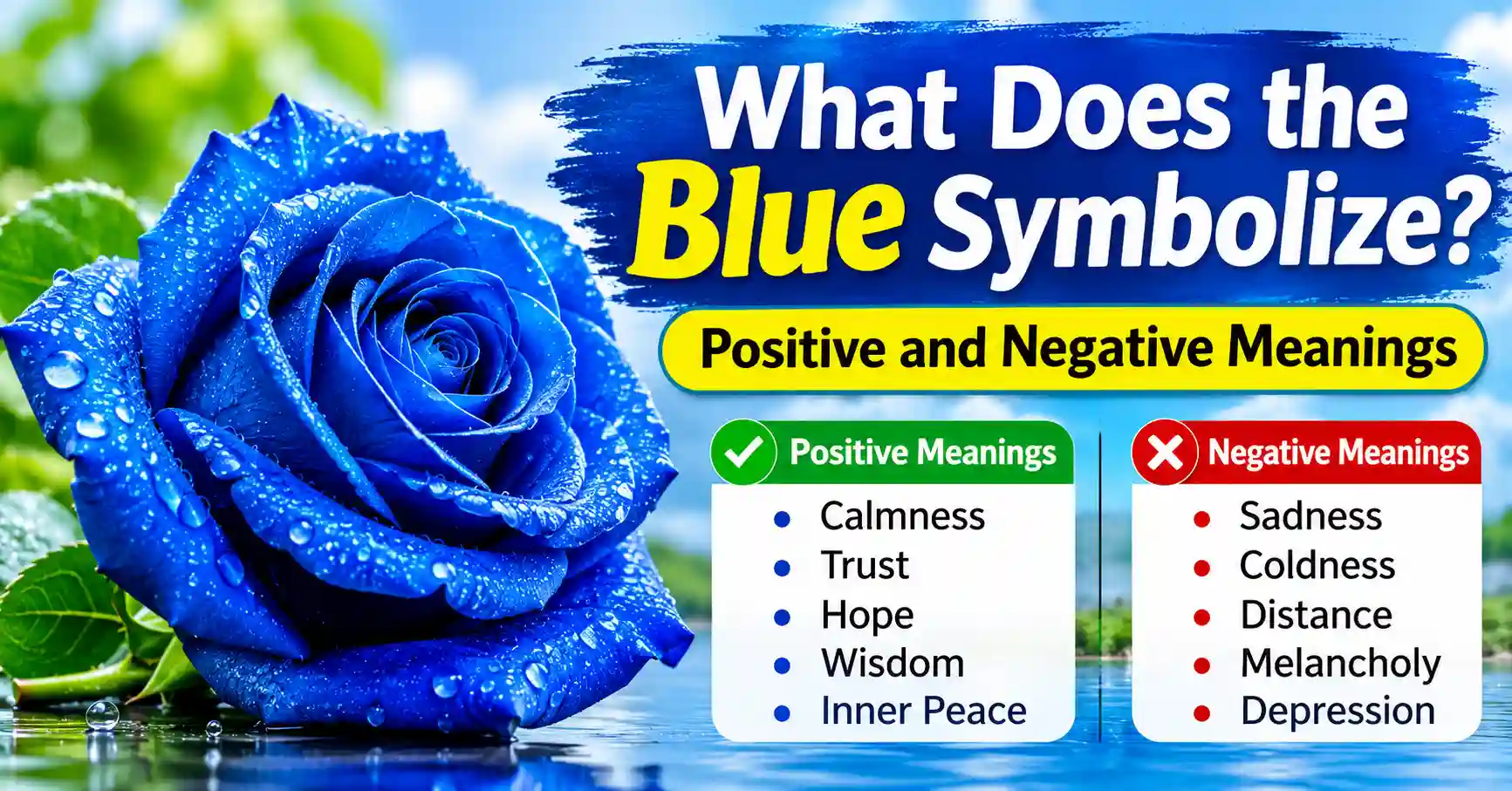

Quick Answer: What does the color blue symbolize? Blue traditionally stands for the sky and sea, so it carries meanings of calm, trust, faith, and protection. It also has a darker side, linked to sadness, coldness, and distance. Both sides come from one idea: blue is the color of things we can see but never touch.
So, What Does the Color Blue Symbolize at Its Core?
Blue is the color of things that look close but stay out of reach. The sky, the horizon, the deep sea, and far-off mountains all seem blue because of distance and depth. That one idea explains why blue can feel so soothing and so lonely at the same time. Keep it in mind as we walk through the bright and dark sides of blue.

The sky above and the sea below
Look up on a clear day, and you see blue. Look out at open water, and you see it again. These are two of the biggest things in any human life, and both seem to have no end. So people began to link blue with the infinite, with heaven, and with powers much larger than themselves. Many old stories place the sacred somewhere high, wide, and blue.
Why blue cuts both ways
You can pick a red apple or a yellow flower. You cannot pick up the sky. Because blue sits just beyond our grasp, it feels peaceful, since far-away things are quiet. It also feels lonely, for the very same reason. Nearly every positive meaning of blue grows from that calm distance. Nearly every negative meaning grows from the cold side of it.
Read More: Turquoise Color Meaning: Psychology, Symbolism & Cultural Significance
The Positive Meanings of Blue
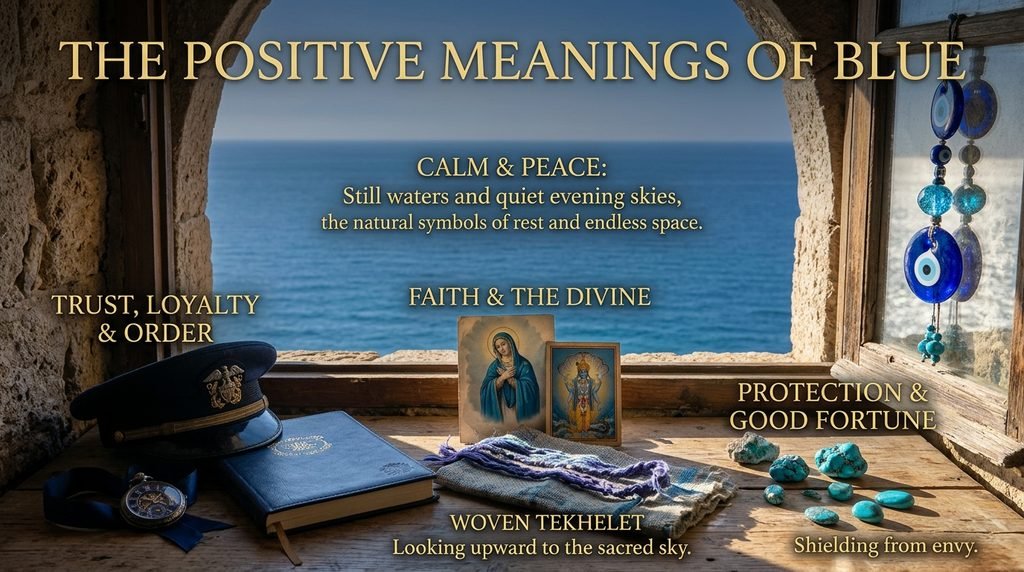
Let’s start with the bright side. In many cultures, blue stands for calm, trust, faith, and protection. These meanings feel natural because the sky and the sea are steady and reliable. They are always there, and they are always large. Here are the four positive meanings you will see most often.
Calm and peace
Think of a still lake or a quiet evening sky. Blue is often the color people picture when they imagine peace. This is because the big blue things in nature, like open skies and calm seas, tend to feel slow and wide. Writers and artists use blue to say “everything is quiet now.” It is a symbol of rest, even when the world around it is busy.
Trust, loyalty, and order
Blue is a favorite for uniforms in many countries, from police to navy to airline staff. Deep navy in particular suggests steadiness and duty. It does not shout. It stands quietly and keeps its place, much like the sky. This is why blue is often read as a symbol of loyalty, order, and a promise kept. The phrase “true blue” even uses the color to mean someone who stays faithful.
Faith and the divine
If the sky is the home of the sacred, then blue is its natural color. Many traditions use blue to point upward. In Christian art, blue often marks heaven and the Virgin Mary. In Jewish tradition, a blue-purple thread called tekhelet was worn on the fringes of garments. Each tradition tells its own story, but all of them look to the sky.
Protection and good fortune
Across Turkey, Greece, and much of the Mediterranean and Middle East, people hang blue glass eye charms on doors, cars, and baby clothes. The idea is that the charm looks back at envy and turns it away. Why blue? Nobody knows for sure, but many explanations point to its link with the sky. In this tradition, blue acts like a shield. Many people also treasure the blue-green stone turquoise as a lucky and protective gem.
Explore More Ideas: Lavender Color Meaning: Symbolism, Psychology & Spiritual Significance
The Negative Meanings of Blue
Now for the other side. The same distance that makes blue calm can make it cold. What feels deep can start to feel heavy. So blue also stands for sadness, emotional chill, loneliness, and, in some English phrases, crude humor. These meanings are real, but they are not universal, and it helps to see where each one comes from.

Sadness and sorrow
In English, “feeling blue” has meant feeling sad for a long time. The blues, a musical form that grew out of African American communities, took that word and turned grief into art. In that tradition, blue is the sound of honest sadness, not weakness. The link between blue and sorrow is strongest in English-speaking cultures. Other languages and traditions may tie sadness to other colors, so this meaning is not a global rule.
Coldness and emotional chill
Blue is the color of ice, winter shadows, and cold steel. That is why a cold mood or a cold stare is often pictured in blue. In films and stories, a blue-lit scene often signals that something is distant or unfriendly. This is symbolism at work, not a judgment of any real person. The same blue that calms a bedroom can chill a lonely street at night.
Image caption suggestion: “Pale blue ice: the cooler, lonelier side of blue symbolism.”
Distance and loneliness
Because blue is the color of the faraway, it can also stand for being left outside. Think of the longing in a view of a distant, blue-tinted hill. Stories often use blue for a person who feels cut off, or for a goal that seems impossible to reach. The color suggests a gap that is hard to cross. In this sense, blue holds both the comfort of the horizon and the ache of never arriving.
Crude jokes and adult content
In English, “blue” has also been used for adult or off-color material, as in a “blue joke” or a “blue movie.” The exact origin is debated, and the meaning is mostly limited to English-speaking countries. It shows how a color can pick up unexpected meanings over time. This is a good reminder that blue’s symbolism is shaped by language and history as much as by sky and sea.
Why Blue Holds Both Meanings: A Short History
Blue was not always easy to find. Very few plants and animals make true blue pigment. Many blue feathers and butterfly wings get their color from the way tiny surfaces bend light, not from dye. For most of history, people had to make blue themselves or bring it from far away. That effort made blue feel rare and precious, which adds to its mix of honor and distance.

Egyptian blue and the stone of heaven
Ancient Egyptians prized lapis lazuli, a deep blue stone, and used it in jewelry and sacred objects. They also made Egyptian blue, a pigment often described as one of the first ever made by people. It was created by heating a mix of sand, copper, and lime. Blue appeared in art linked to the sky, the Nile, and the divine. The god Amun was often painted with blue skin, tying the color to air and the heavens.
Ultramarine: the pigment that crossed the sea
Later, artists in medieval and Renaissance Europe used ultramarine, a pigment ground from lapis lazuli. The stone traveled a long way, and the name means “beyond the sea.” Ultramarine was famously expensive, so painters often saved it for their most honored subjects. That is one reason the robes of the Virgin Mary are so often painted deep blue. The color itself said, “this figure matters.”
Indigo: blue made by hand
Indigo came from plants and dyed cloth in many places, including India, West Africa, and Japan. Making it took skill and patience, because the dye turns blue as the fabric meets air. Because it was widely traded, indigo also became tied to heavy labor and, in some regions, to a painful colonial history. So blue carries stories of beauty and of burden at the same time.
What Blue Means in Different Cultures
Blue does not mean the same thing everywhere. In some places it guards, in some it divides, and in others it shares a name with green. These differences are not mistakes. They show that a color’s meaning is built by people, place by place. Here are a few examples worth knowing.
Blue in Christian art
In Christian art, blue often stands for heaven, mercy, and purity. Mary is commonly shown in a blue mantle, which linked her to the sky and to her title Queen of Heaven. Painters used the best blue they could afford to show respect. Not every artist followed this pattern, and shades changed over the centuries. Still, the link between blue and the heavenly is easy to spot in old paintings and church windows.
Tekhelet in Jewish tradition
The Torah describes a blue-purple thread in the fringes, called tzitzit, worn on the corners of garments. Later rabbinic teaching linked this blue to the sea, the sky, and the throne of glory. The idea was simple: looking at the blue thread leads the mind upward, toward the commandments. The exact source of the ancient dye was lost for a long time, and scholars still discuss it today.
Krishna, Vishnu, and Shiva’s blue throat
In Hindu art, Krishna and Vishnu are often shown with blue or dark blue skin. This is commonly read as a sign of the limitless sky and ocean. Shiva is called Neelkanth, “the blue-throated one,” from the story that he held poison in his throat to save the world. Here, blue stands for the infinite and also for protective sacrifice. Artists in different regions paint the shade differently.
Qing in China: blue that shares a name with green
In classical Chinese, the word qing can cover blue, green, and even blackish tones. Traditional thought linked it with the east, with spring, and with growing wood. It is also tied to the Azure Dragon, one of the guardians of the sky. Here blue is less about distance and more about fresh life. A few other languages also use one word for both blue and green, which shows that every culture draws its color map a little differently.
Blue on the political map
In the United Kingdom and many European countries, blue has long been used by conservative parties. In the United States, in recent decades, blue has become the color of the Democratic Party instead. Same color, opposite sides of the spectrum. A color’s meaning is only as steady as the story told around it, and stories change with time and place.
You May Also Like: Silver Color Meaning: Symbolism, Personality Traits & Spiritual Significance
Shades of Blue and Their Different Moods
Not every blue speaks in the same voice. Light and dark blues lean toward different parts of the story. Think of it as the same song played in different keys. A small change in shade can move the meaning from serious to gentle, or from distant to protective.

Navy and midnight: depth and duty
Deep navy is the blue of the night sea and of naval uniforms. It leans toward depth, seriousness, and quiet authority. Because it is dark, it also hints at things hidden and secrets kept. Navy often appears where people want to show formality without harshness. For a closer look at this shade, see [INTERNAL LINK: navy blue].
Sky blue and baby blue: openness and gentleness
Light blue reminds people of an open, clear sky. It stands for hope, freedom, and a gentle mind. In many Western countries, baby blue has been used for newborn boys. That custom is relatively modern and is not shared everywhere. Light blues feel soft because they carry the sky without the weight of the deep sea.
Turquoise and teal: the blue that meets green
Turquoise sits between blue and green, and the stone of the same name has been prized by many peoples for jewelry and protection. Here blue gains some of green’s warmth and life. To follow this shade further, visit [INTERNAL LINK: turquoise color meaning].
Frequently Asked Questions
What does blue symbolize?
Blue traditionally symbolizes the sky, the sea, calm, trust, faith, and protection. Its darker meanings include sadness, coldness, and distance. Both sides grow from one idea: things we can see but not touch.
What does the color blue represent spiritually?
In many traditions, blue represents heaven, the infinite, and a link between people and the divine. Examples include the Virgin Mary’s blue mantle, the blue thread of tekhelet, and the blue skin of Krishna and Vishnu. Each tradition has its own meaning, so blue’s spiritual role varies.
Is blue a positive or negative color?
Mostly positive, but not only. Blue is often tied to calm, loyalty, and protection, and it can also suggest sadness or coldness. Context and shade decide which side shows up.
What does blue symbolize in different cultures?
In Mediterranean and Middle Eastern cultures, blue charms guard against the evil eye. In classical Chinese thought, qing joins blue and green and links to spring and the east.
Why does “feeling blue” mean feeling sad?
The phrase has been used in English for a long time, and the exact origin is debated. The blues music tradition later made the link even stronger. This meaning is mainly found in English-speaking cultures.
Why is blue so rare in nature, and does that affect its meaning?
Few living things make true blue pigment. Many blue feathers and wings get their color from how light bends on tiny surfaces. This rarity helped make blue feel special, and it helps explain why people worked so hard to create blue dyes and paints.
Conclusion
So, what does the color blue symbolize? On the bright side, it stands for calm, trust, faith, and protection. On the darker side, it speaks of sadness, cold, and distance. Both come from the same far-off sky and deep sea. To see how a small change in shade shifts the story, continue to [INTERNAL LINK: turquoise color meaning]. Blue reminds us that the things we long for and the things that calm us are often the same.